.png?branch=web_prod)

A Brief History Of Hearing Aid Technology

A Brief History Of Hearing Aid Technology
8 min.
Publication Date: 8 September 2021
From their modest beginnings in the 17th Century, hearing aids have had an interesting history. Many landmark improvements have helped shape the devices we know today.
We’ve charted the most important developments below.
Ear trumpets
The earliest instruments designed to aid hearing emerged in the 1600s. Known as ‘ear trumpets’, these tube or funnel shaped devices worked by collecting sound waves and funneling them towards the user’s ears.
They were made from a variety of materials, including iron, silver, wood and animal horns, but were rudimentary and offered average amplification at best.
Even at this early stage there was a push to make hearing aids smaller and less conspicuous. It became increasingly popular through the 18th Century to conceal ear trumpets in clothing or accessories.
Electric hearing aids
The invention of the microphone and telephone led to the development of the first electronic hearing aid in the 19thCentury. In 1898, Miller Reese Hutchison developed the Akouphone, in which a carbon transmitter amplified weak signals with an electric current.
Soon after, in 1920, vacuum-tube hearing aids were developed. They converted sound into an electric signal and amplified it at the receiver.
The next electric breakthrough came with the invention of the transistor in the 1940s, which replaced vacuum-tubes with smaller components that required less power and gave an even clearer signal. Transistors allowed hearing aids to become truly portable, and with new materials like silicon, the behind-the-ear hearing aid became the basis for most modern aids.
Digital technology
The next major milestone in the hearing aid timeline was the invention of the microprocessor, which allowed aids to become even smaller and more powerful.
At first, hybrid devices used a combination of digital and analogue features, but the addition of digital chips has turned hearing aids into virtual microcomputers with high-speed digital sound processing.
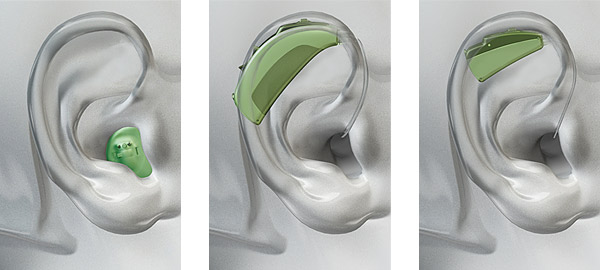
Today, fully digital models allow greater flexibility and devices can be fine-tuned to the user’s specific need. Miniature, discrete devices with high sound quality and wireless connectivity are features that characterise modern hearing aids. Some devices, like the Lyric, sit inside the ear and are completely invisible.
What’s next?
Work is constantly being done to develop new hearing solutions.
Hearing aids may one day rely on visual cues to tune noise in and out, or may be permanently implanted in the ear canal, drawing energy from the body to charge themselves. Excitingly, advancements in stem cell research may mean that hearing restoration will even be possible one day.
To learn more about new hearing technology, explore the different types of hearing aids available today.
.png?branch=web_prod)